THE FIRST COLLECTION
Crispy Parmesan Chicken with Lemon Pan Sauce
A golden Parmesan-panko crust, bright lemon-butter sauce, and a sauce-ahead method that protects the crust.
Desk-reviewed recipes. Times are estimates for the stated ingredients and equipment.
THE RESTAURANT MOVE
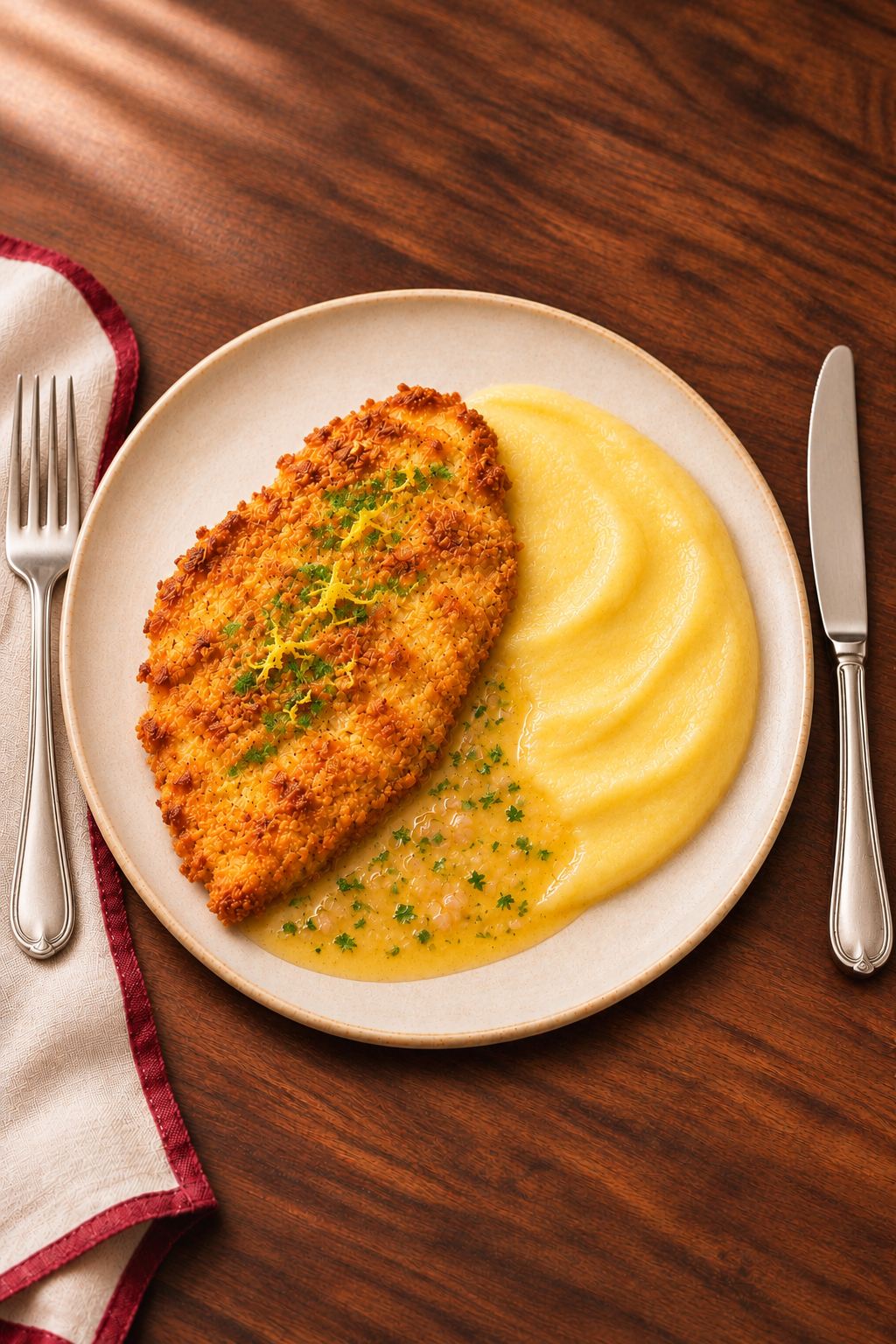
Build the crust. Protect the crust. Dry the chicken, make its thickness even and give each cutlet space. After frying, let steam escape on a clean oven rack. Put the sauce on the polenta and beside the chicken, with only a small overlap under one edge.
Before you cook: Plan the batches and protect the crust
- Makes four portions: one cutlet per person, one quarter of the polenta and one quarter of the sauce available for serving.
- Dish alone: provisionally allow 50–75 minutes. Chicken with polenta: 65–95 minutes. These are conservative one-cook desk estimates from a cold start, not measured cooking times.
- The preferred estimate assumes two cutlets fit flat without touching in the actual skillet. A 12-inch rim does not guarantee that capacity. If only one fits, fry four batches and allow approximately 75–110 minutes for the dinner. That longer holding scenario has an unresolved crispness risk and is not the recommended configuration.
- The oven preheats during preparation. No two attended cooking tasks overlap. Further cooking to reach safe temperature, unexpected equipment delays, or extra hydration can exceed the ranges.
The revised garnish allocation adds an estimated 30–60 seconds, conservatively included at final service. Rounded planning ranges remain unchanged; this is not measured timing.
Equipment & batch plan
A heavy 12-inch skillet; instant-read thermometer; oven; clean oven-safe wire rack on a rimmed sheet pan large enough for four cutlets in a single layer; separate raw-chicken tray and raw/cooked tongs; three shallow breading dishes; board, knife and mallet or rolling pin; fine grater; heatproof measuring jug for the sauce base; and four plates.
Ingredients & cooking
4 servings · Written quantities. Changing servings needs a new batch and timing plan.
50–75 minutes estimated
Ingredients
Chicken
- 2 large boneless, skinless chicken breasts, about 1¼ lb total
- ¾ tsp kosher salt
- ½ tsp freshly ground black pepper
- ½ cup all-purpose flour
- 2 large eggs
- 1 tbsp water
- 1½ cups panko breadcrumbs
- ½ cup finely grated Parmigiano-Reggiano
- ¼ cup canola oil, divided, plus a little more only if the pan needs it; refined avocado or grapeseed oil may be used instead
Lemon pan sauce
- 1 small shallot, very finely minced, about ¼ cup
- 1 tbsp unsalted butter, for the shallot
- ½ cup dry white wine
- ¾ cup low-sodium chicken cooking broth
- 1 tbsp fresh lemon juice, plus more only after tasting
- 2 tbsp cold unsalted butter, cut into four pieces
- 1 tbsp finely chopped flat-leaf parsley, divided: 1½ tsp for the sauce and 1½ tsp for finishing all four plates
- 1 tsp finely grated lemon zest, for finishing
- Kosher salt and black pepper, only after tasting
- Up to 3 tbsp water, only to restore an over-reduced sauce base or loosen a broken sauce
Shopping checklist
Let’s cook
Set up the clean work first. Heat the oven to 200°F. Set the clean rack and sheet pan inside. Mince the shallot and grate the cheese. Wash and thoroughly dry the parsley, then finely chop and measure 1 tbsp total. Reserve 1½ tsp for finishing and keep the other 1½ tsp for the sauce. Zest and juice the lemon. Measure the sauce ingredients and keep the finishing butter cold. Set out the separate raw tray, breading dishes and four plates.
Reduce the sauce base before frying. Melt the shallot butter in the skillet over medium-low heat. Add the shallot and cook, stirring, until tender and translucent without browning, about 2–3 minutes; give it longer if it still tastes raw. Take the pan off the burner before adding the wine, then return it to medium heat. Simmer until about 2 tbsp wine remain, approximately 3–4 minutes. Add the cooking broth and simmer until the base measures about ½ cup, approximately 4–6 minutes. The volume, not the clock, is the endpoint. Transfer to the clean heatproof measuring jug and cover. Do not add lemon, parsley or finishing butter yet. Wipe and dry the skillet. This is same-session preparation, not a room-temperature make-ahead sauce.
Make four even cutlets. Split each breast horizontally into two cutlets. Put each between parchment and pound the thick spots to an even ¼ inch. Pat dry. Season all four cutlets with the measured chicken salt and pepper. Do not rinse raw chicken.
Bread and clear the raw station. Put flour in the first dish. Beat the eggs with the tbsp water in the second. Mix panko and Parmesan in the third. Coat each cutlet lightly in flour, shake off the excess, dip completely in egg and let excess drip off, then press into the crumbs. Put on the raw tray and refrigerate until ready to fry. Discard leftover raw-contact coating. Wash hands and clean the raw board, counter and utensils before touching cooked food or finishing ingredients.
Fry without crowding. Heat the dry skillet over medium heat for about 2 minutes, then add 2 tbsp oil. When the oil shimmers but does not smoke and a loose crumb sizzles steadily, add at most two cutlets, only if both fit flat without touching. Do not test oil with water. Cook without moving until the underside is deep golden and releases, about 2–3 minutes. Turn and cook the other side for about 2 minutes, adjusting the heat if the Parmesan darkens too quickly. Insert a clean thermometer horizontally into the thickest part. Every cutlet must reach 165°F; color or the estimated time is not proof. If the crust is ready first, lower the heat and continue cooking to temperature.
Hold the first batch correctly and repeat. Move cooked cutlets with clean tongs to the oven rack, uncovered and in one layer. Check that food remains at least 140°F during hot holding; the oven setting alone does not establish this. Remove black crumbs before the next batch, retaining useful golden fond. Add only enough of the remaining measured oil to restore a thin frying film, then use extra only if needed. Cook the remaining cutlets to 165°F. Clean the probe after contact with undercooked chicken. The revised modeled first-batch wait is roughly 13½–21 minutes in the two-batch dinner, conservatively charging the extra garnish work to service. This is an exposure to evaluate, not a validated crispness allowance.
Pick up the fond and finish the sauce. Pour off excess frying oil into a heatproof waste container. Wipe away black or bitter crumbs; if all the residue is burned, clean the pan and use the prepared base alone. Return the sauce base to the skillet and bring to a brief simmer, scraping up golden browned bits. If it has reduced below about ½ cup, restore with measured water a tbsp at a time, then simmer briefly. Take off the heat. Add the tbsp lemon juice, then swirl or whisk in the cold butter one piece at a time. Stir in 1½ tsp of the parsley, keeping the reserved 1½ tsp for finishing. The sauce should look glossy and lightly coat a spoon. Taste safely now, after the raw-chicken contact stage has been fully cooked. Add lemon only if it needs brightness, and salt only if it needs seasoning. Do not boil after adding the finishing butter. If the sauce separates, take it off the heat and whisk in a tsp of the available water; this recovery is a desk proposal, not a measured pass.
Plate all four portions promptly. Put one cutlet on a mostly dry part of each of four plates. Start with about 2 tbsp sauce beside the chicken, with only a small overlap beneath one edge. Keep the upper crust dry. Scatter the reserved 1½ tsp parsley and the existing 1 tsp lemon zest lightly over the chicken on all four plates, leaving the crust visible and dry. Serve immediately, passing any actual remaining sauce. Do not promise a surplus before measuring the batch.
Equipment
A heavy 12-inch skillet; instant-read thermometer; oven; clean oven-safe wire rack on a rimmed sheet pan large enough for four cutlets in a single layer; separate raw-chicken tray and raw/cooked tongs; three shallow breading dishes; board, knife and mallet or rolling pin; fine grater; heatproof measuring jug for the sauce base; and four plates.
Storage & reheating
Keep raw and cooked tools separate. Cook poultry to 165°F. Keep food held hot at or above 140°F. If a holding temperature falls during this brief, known cooking session, promptly reheat to 165°F; reheating does not rescue food left out beyond safe time limits. Refrigerate in shallow containers within 2 hours, or 1 hour above 90°F. Discard food that exceeds those limits or has an unknown unsafe holding history.
Store chicken, polenta and sauce separately in the refrigerator at or below 40°F and use within 3 days for this combined-dinner guidance. Reheat chicken on a rack in a 400°F oven to 165°F, watching that the crust does not burn. Reheat polenta to 165°F while loosening with liquid. Bring leftover sauce to a rolling boil and 165°F; the emulsion may split. Reheated texture will differ from the fresh dinner.
Make it a meal.
65–95 min complete-dinner estimate
Creamy Parmesan Polenta
Creamy Parmesan Polenta
- 1½ cups low-sodium chicken stock
- ¾ cup water
- ¾ cup whole milk
- ¼ tsp kosher salt, plus more only after tasting
- ¾ cup dry quick-cooking or instant yellow polenta with a stated cook time of 3–8 minutes
- 2 tbsp unsalted butter
- ⅓ cup finely grated Parmigiano-Reggiano
- Freshly ground black pepper, to taste
- Up to ½ cup additional water, for cooking and loosening, heated as described below
Ingredient boundaries. Use dry quick polenta, not prepared tube polenta. Regular medium- or coarse-ground polenta needs a separate long-cook workflow. Keep the polenta stock and chicken-sauce cooking broth as separate allocations. Kosher salts differ: these are conservative starting spoon measures, with the cooked sauce and polenta tasted before any extra. No claim of a low-sodium finished meal is made.
Select the chicken-and-polenta dinner for its coordinated cooking steps. The illustration shows the chicken with optional Parmesan polenta. Polenta is excluded from main-only ingredients and nutrition.
Estimated nutrition per serving
One of four equal portions; listed-input estimate, not measured intake.
- Calories
- 620 kcal
- Protein
- 45 g
- Carbohydrate
- 31 g
- Fat
- 32 g
- Fiber
- 2 g
- Sodium
- 550 mg
Calculation scope & assumptions
Chicken and one quarter of all prepared sauce only. Counts initial breading and frying oil before discard or retention losses; extra oil, seasoning and conditional recovery water excluded. Not alcohol-free.
Estimated from USDA food-composition data and representative manufacturer labels. Actual products and amounts eaten can differ. No cooked serving mass or nutrient retention was measured.
Ingredient-based desk estimate, not laboratory analysis or measured consumed intake.
Safety and leftovers
Keep raw and cooked tools separate. Cook poultry to 165°F. Keep food held hot at or above 140°F. If a holding temperature falls during this brief, known cooking session, promptly reheat to 165°F; reheating does not rescue food left out beyond safe time limits. Refrigerate in shallow containers within 2 hours, or 1 hour above 90°F. Discard food that exceeds those limits or has an unknown unsafe holding history.
Store chicken, polenta and sauce separately in the refrigerator at or below 40°F and use within 3 days for this combined-dinner guidance. Reheat chicken on a rack in a 400°F oven to 165°F, watching that the crust does not burn. Reheat polenta to 165°F while loosening with liquid. Bring leftover sauce to a rolling boil and 165°F; the emulsion may split. Reheated texture will differ from the fresh dinner.
Allergens and boundaries
Contains wheat, egg and milk. Check broth, stock and wine labels for additional ingredients, including sulfites. Wine reduction does not establish that the dish is alcohol-free. Gluten-free, dairy-free, wine-free, different-cut, different-polenta and scaled-serving versions are not validated by this recipe.