THE FIRST COLLECTION
Rigatoni alla Vodka
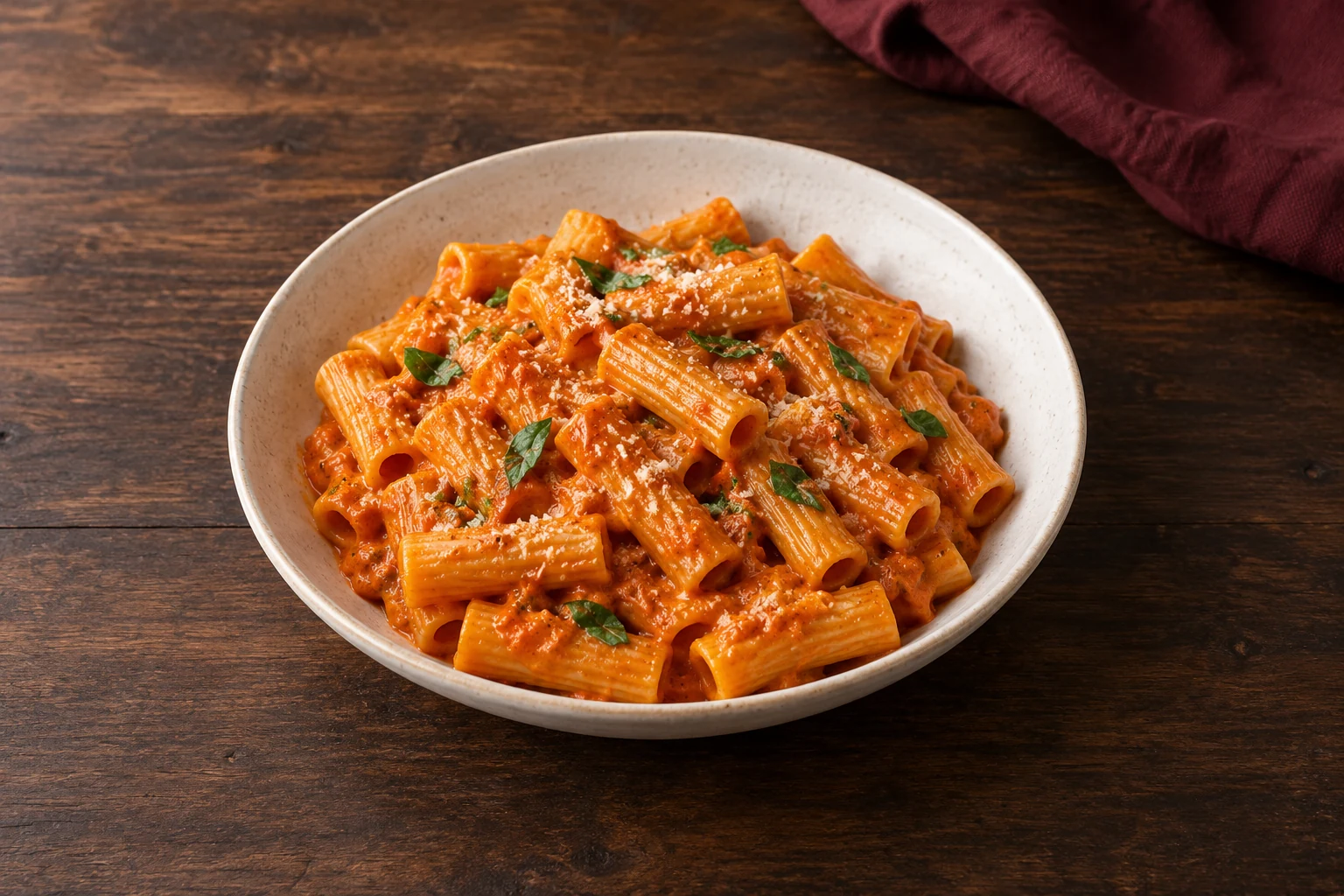
Ridged rigatoni wrapped in a glossy tomato-cream sauce, with concentrated tomato flavor in every tube.
Desk-reviewed recipes. Times are estimates for the stated ingredients and equipment.
THE RESTAURANT MOVE
Build the emulsion in the pan. Cook the paste to its brick-red endpoint, finish the undercooked pasta in the sauce with reserved water, then add cheese and butter off heat. Add water gradually until the coating flows around the tubes. Learn the reduced-tomato branch of Method 002, Emulsify with Starch.
Before you cook: Give the sauce a head start
Unmeasured one-cook estimates: pasta only 38–57 minutes; selected dinner provisionally 45–70 minutes, including raw-nut toasting/cooling, cold water, preparation and service. Actual equipment, pasta package and finishing decisions can take longer. No 45-minute dinner claim.
Four generous portions. Pasta package al-dente time: 10–13 minutes. Start pasta only after the tomato paste reaches its cooked endpoint; the cream base must be ready before draining.
Equipment & batch plan
- Pasta pot (6-quart or larger) — required
- High-sided skillet or sauté pan (4-quart sauté pan, or a high-sided 12-inch skillet with capacity to stir the entire batch) — required
- Fine grater — required
- Heatproof cup (Holds 1 1/2 cups reserved pasta water) — required
- Colander — required
- Knife and cutting board — required. Keep raw-food handling separate from ready-to-eat food.
- Two usable burners — required for the selected dinner
- Kitchen scale for the 2 oz cheese; four shallow serving bowls.
Ingredients & cooking
4 generous servings · Written quantities. Changing servings needs a new batch and timing plan.
38–57 minutes estimated
Ingredients
- 1 lb rigatoni
- 2 tbsp extra-virgin olive oil
- 1 small yellow onion, very finely chopped, about 1 cup
- 4 medium garlic cloves, finely grated or minced
- 1/2 tsp red pepper flakes, plus more to taste
- 1 can no-added-salt tomato paste, 6 oz
- 1/3 cup vodka
- 1 cup heavy cream, measured at the start of preparation
- 2 oz finely grated Parmigiano-Reggiano; use the weight, not a packed-cup target, plus more for serving
- 2 tbsp unsalted butter, cut into pieces
- 1 1/2 tsp kosher salt for the pasta water, a small pinch for the onion, and extra only after tasting
- 1/4 cup loosely packed basil leaves, torn, optional
Kosher salts vary; use the listed starting amount, then adjust the finished food to taste.
Shopping checklist
Let’s cook
Start the water and prepare the ingredients. Bring 4 quart water to a boil in a 6-quart or larger pot, leaving room for the pasta. Add 1 1/2 tsp kosher salt. Complete the pasta mise en place. Measure the cream now; do not leave it out for an extended period. Set out warm pasta bowls. Omit the nuts and all salad preparation for pasta only.
Sweat the onion. While the water heats, warm the olive oil in a 12-inch high-sided skillet over medium. Add the onion and a small pinch of salt. Cook, stirring occasionally, until translucent and completely tender without browning, 5 to 7 minutes.
Wake up the aromatics. Add the garlic and red pepper flakes. Stir until fragrant, about 30 seconds; do not let the garlic color.
Cook the tomato paste, then start the pasta. Add the paste and spread it across the pan. Cook, stirring and scraping frequently, until brick red with a light film on the pan and a sweet, cooked aroma, 4 to 6 minutes. Only after that endpoint, add the rigatoni to the boiling water and stir. Use pasta with a package al-dente time of 10 to 13 minutes; set a timer for 2 minutes less. Continue immediately with the vodka and cream. If the water is not boiling, briefly take the paste pan off heat rather than scorch it. Do not drain and hold the pasta while making the base.
Reduce the vodka. Take the skillet off the burner before pouring in the vodka, especially over gas. Return to medium heat, scrape up the tomato film, and cook until the pan is nearly dry, about 2 to 3 minutes. Reduced aroma is a flavor cue, not proof that all alcohol is gone.
Build the cream base before draining. Lower the heat to medium-low and stir in the cream until no pale streaks remain. Bring to a gentle simmer. The base should now be ready before the pasta. Keep it on the lowest heat only briefly, or take it off heat if it begins reducing too far. Rewarm gently just before adding the pasta. Do not boil aggressively.
Undercook and reserve. Check the rigatoni 2 minutes before its package al-dente time. Reserve 1 1/2 cups cooking water, then drain and transfer directly into the ready cream base. Do not rinse or leave drained pasta waiting. If your pasta has a shorter package time than 10 minutes, finish the cream base before starting it and allow additional elapsed time.
Finish in the sauce. Add the rigatoni and 1/2 cup pasta water to the skillet. Raise the heat to medium. Toss or stir continuously until the pasta is al dente and the sauce visibly clings inside and outside the tubes, 1 to 3 minutes. Add more pasta water 2 tbsp at a time if the pan looks tight before the pasta is ready.
Emulsify off heat. Remove the skillet from the heat. Add the Parmigiano-Reggiano in three additions, tossing thoroughly after each. Add the butter and continue tossing until melted. The sauce should look glossy and move slowly around the pasta; loosen with another spoonful of pasta water if it looks pasty.
Balance and serve. Taste before adding salt. Adjust the heat with red pepper flakes and fold in the basil, if using. Spoon into warm shallow bowls and finish with Parmigiano-Reggiano. Serve immediately.
Equipment
- Pasta pot (6-quart or larger) — required
- High-sided skillet or sauté pan (4-quart sauté pan, or a high-sided 12-inch skillet with capacity to stir the entire batch) — required
- Fine grater — required
- Heatproof cup (Holds 1 1/2 cups reserved pasta water) — required
- Colander — required
- Knife and cutting board — required. Keep raw-food handling separate from ready-to-eat food.
- Two usable burners — required for the selected dinner
- Kitchen scale for the 2 oz cheese; four shallow serving bowls.
Storage & reheating
Refrigerate leftovers promptly in shallow containers within 2 hours, or within 1 hour above 90°F. Keep the refrigerator at 40°F or below and use within 3 days. Do not leave the full pan on the counter to cool. Reheat finished pasta gently with 1 to 2 tbsp water per serving, stirring until it reaches 165°F throughout. If reheating sauce stored separately, bring that sauce to a rolling boil while stirring; cream may separate. Freezing is not recommended.
Make it a meal.
45–70 min complete-dinner estimate
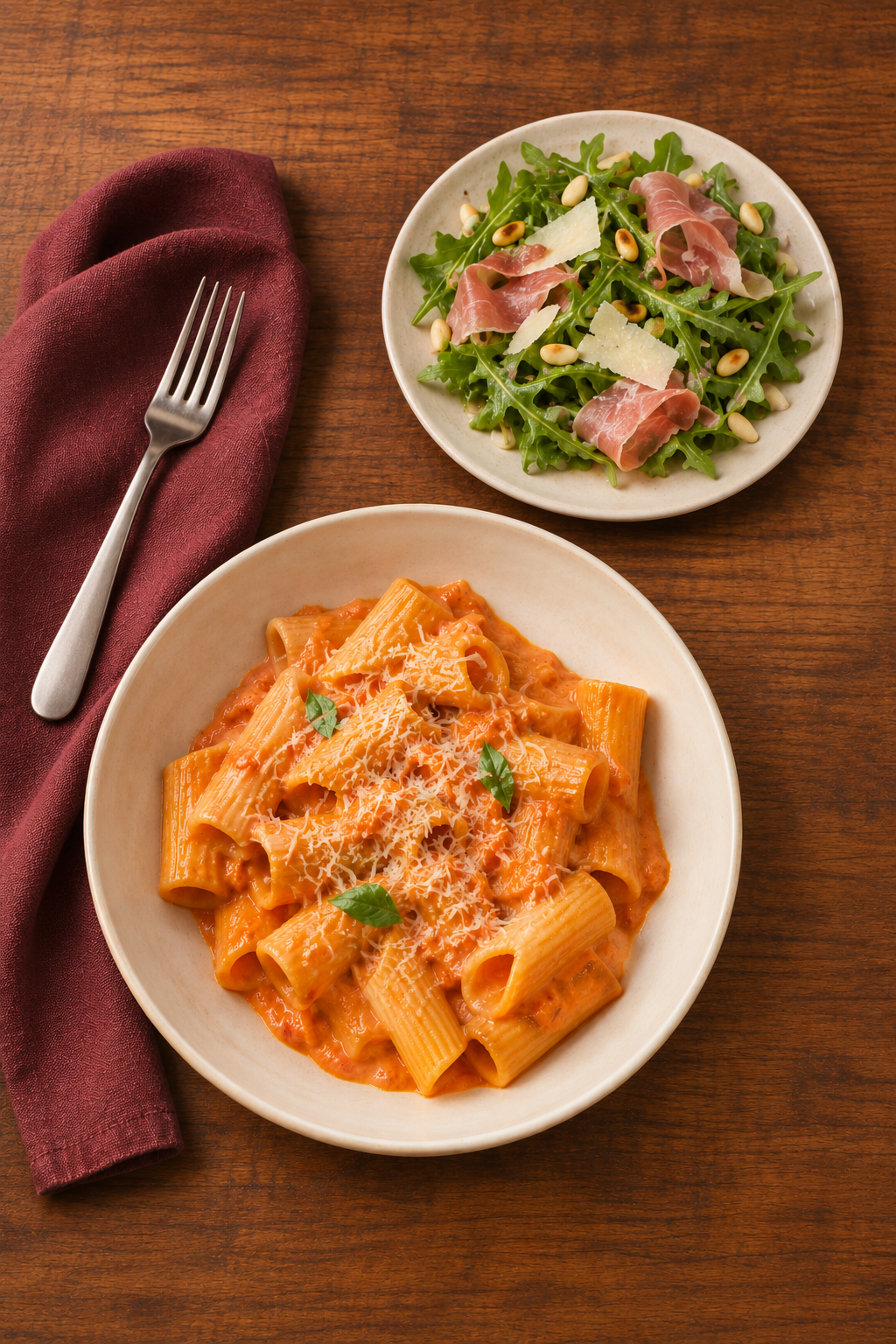
Arugula Salad with Parmesan, Pine Nuts and Prosciutto
Four side portions. Adapted from Erin Lynch’s Arugula Salad with Red Wine Vinaigrette at Platings & Pairings, with 2 oz prosciutto added for four portions. This adaptation has not been physically tested.
Salad
- 5 oz arugula
- 1/4 cup pine nuts, toasted and cooled
- 1/4 cup shaved Parmesan, separate from the pasta’s 2 oz cheese
- 2 oz ready-to-eat prosciutto, torn into loose bite-size ribbons
Red-wine vinaigrette
- 1 shallot, peeled and very finely minced
- 1/4 cup extra-virgin olive oil
- 2 1/2 tsp red wine vinegar
- 1 tsp honey
- 1 tsp Dijon mustard
- Kosher salt and freshly ground black pepper, after tasting
- Toast early. If the nuts are raw, put them in the dry sauce pan before starting the pasta sauce. Heat over medium-low, stirring and watching continuously, until pale golden and fragrant, about 3 to 5 minutes after warming begins. Transfer immediately to a cool plate in a single layer. Do not leave them in the hot pan or attend another cooking task while toasting. Purchased toasted nuts can skip this step; do not inherit a shorter measured dinner claim.
- Prepare the cold components. Wash and thoroughly dry the arugula unless its package says it is ready to eat. Shake or whisk the shallot, oil, vinegar, honey and Dijon until combined. Keep the dressing separate. Shave the salad cheese and tear the prosciutto, then keep both the cheese and prosciutto separately covered and refrigerated at or below 40°F until service. Let the nuts cool while preparing the remaining ingredients.
- Dress at the last moment. After the pasta’s final off-heat finish, shake the dressing again. Start with about 2 tbsp over the greens and toss gently. Add a little more only if needed for a light coating; the full batch is not automatically used. Divide the greens among four side plates and distribute all the pine nuts, shaved Parmesan and prosciutto. Taste a complete bite before adding salt or pepper. Serve beside the pasta immediately, not beneath its hot sauce.
Whole-dinner plan. Start cold pasta water, toast the nuts first, complete the pasta mise en place and prepare the salad components. Use interruptible salad prep while the onion softens, pausing for its checks. No salad chopping or nut toasting occurs during the final pasta emulsion. Dress and add toppings only at service. Two burners, one pasta pot and one sauce pan; all toppings remain separate from the pasta recipe.
Storage and allergens. Contains milk, pine nuts and mustard; includes pork. Check condiment and prosciutto labels. Refrigerate prosciutto and prepared dressing at or below 40°F and follow the meat package’s shorter opening/use-by limit. Refrigerate perishable components within 2 hours, or 1 hour above 90°F. Keep greens, toppings and unused dressing separate. Prepare the combined dressed salad for immediate service; no multi-day dressed-salad quality claim is made.
For diners at higher risk of Listeria. For pregnant diners, adults 65 or older, or anyone with a weakened immune system, do not serve the prosciutto cold. Heat it to 165°F or until steaming hot, or omit it. Choose Parmesan made with pasteurized milk for these diners. This variation needs separate handling and is outside the cold-salad timing estimate. See CDC food-safety guidance.
Estimated nutrition per serving
One of four equal portions; listed-input estimate, not measured intake.
- Calories
- 885 kcal
- Protein
- 23.9 g
- Carbohydrate
- 99.4 g
- Fat
- 39.4 g
- Fiber
- 6.1 g
- Sodium
- 350 mg
Calculation scope & assumptions
Pasta only; excludes salad, extra cheese, optional basil and unquantified final seasoning. Includes initial vodka energy and documented pasta-water sodium scenario. Listed-input editorial estimate, not measured intake. Full initial vodka energy is counted; extra finishing cheese is excluded.
Estimated from USDA food-composition data and representative manufacturer labels. Actual products and amounts eaten can differ. No cooked serving mass or nutrient retention was measured.
Ingredient-based desk estimate, not laboratory analysis or measured consumed intake.
Storage and reheating
Refrigerate leftovers promptly in shallow containers within 2 hours, or within 1 hour above 90°F. Keep the refrigerator at 40°F or below and use within 3 days. Do not leave the full pan on the counter to cool. Reheat finished pasta gently with 1 to 2 tbsp water per serving, stirring until it reaches 165°F throughout. If reheating sauce stored separately, bring that sauce to a rolling boil while stirring; cream may separate. Freezing is not recommended.
Allergens and boundaries
Contains wheat and milk. Vodka is cooked and reduced, but the recipe is not alcohol-free; a separately developed formulation is needed when alcohol must be avoided. The selected salad additionally contains pine nuts and mustard and includes pork; check all ingredient labels. It is not a vegetarian dinner.